

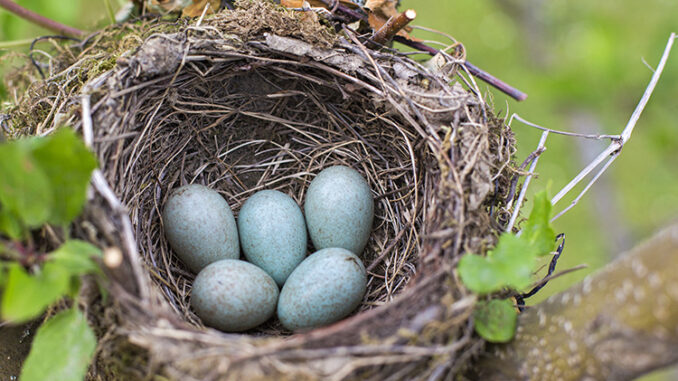
You may have seen some American robin eggs in a nest—light blue, oval-shaped, and about the size of a quarter. A brown hawk owl’s eggs are medium-sized, almost perfectly round, and light brown. Sandpiper eggs are smaller, shaped like a teardrop, and have spots. Bird eggs come in different shapes, sizes, and colors.
Scientists studied eggs from 1,400 bird species (a group of living things with similar traits that are able to reproduce). They found the eggs had a range of shapes from round to elliptical (oval-shaped). Some were asymmetric, meaning they are larger on one end than the other. The scientists wondered how bird eggs get their different shapes.
You might think the shape of the shell determines the shape of an egg. But the scientists already knew the shell did not impact the shape of an egg. So, they tested the membrane (a flexible layer that acts as a barrier) on the inside of the shell instead. They used a computer model and found that the thickness and “stretchiness” of the membrane both affect the shape of an egg. Next, they looked at the role of flight and how it might impact egg shape. They found that birds that spend more time in flight have eggs that are more elliptical or asymmetric. This allows a bird to have a body that is streamlined (shaped to reduce air resistance when moving through air) for flying.
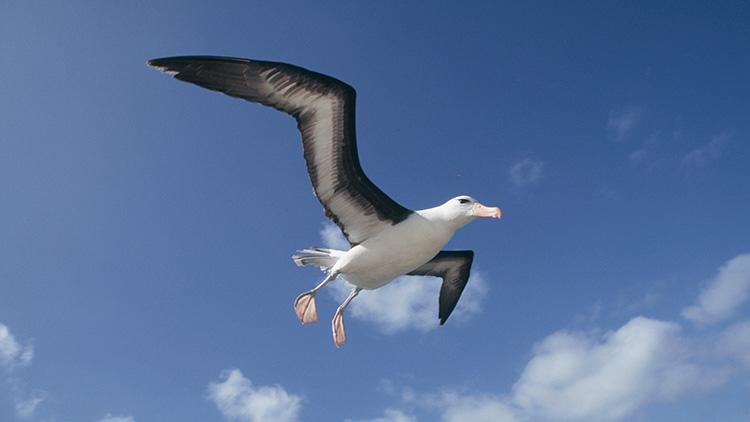

Let’s look at an example. The albatross and hummingbird differ greatly in size. An albatross is a large bird, with a wingspan (distance from the tip of one wing to the tip of the other wing) of about 3.5 meters. Hummingbirds are much smaller, with an average wingspan of about 10 centimeters. Despite the difference in size, both of these birds are great flyers.
Every year albatrosses fly thousands of kilometers across oceans. Hummingbirds don’t fly such long distances, but they spend a lot of time hovering to drink nectar (sugary liquid produced by plants) from flowers. And they can fly backwards and upside down!
Both of these great flyers also have eggs that are elliptical in shape. When eggs are shaped like this, birds can develop and lay the elliptical egg and still have the streamlined body needed for lots of flying. Birds that do not fly as much, like the brown hawk owl, have eggs that are round and symmetrical.
What Do You Think? A common murre is a bird that spends a lot of time flying when it searches for fish in the ocean. Do you think a common murre’s eggs are round or elliptical?
Photo Credit: (t)Oldrich/Shutterstock, (bl)John Giustina/The Image Bank/Getty Images, (br)Jiri Hrebicek/Shutterstock