
Every state in the U.S. has experienced a tornado (a powerful, rotating column of air that touches the ground) at least once. Some places, like Tornado Alley get over 500 tornadoes a year! With winds as high as 200 miles per hour, tornadoes can cause a lot of damage. Fortunately, meteorologists can monitor weather conditions to issue tornado watches and warnings. What are the meteorologists (scientists that study weather) looking for? How do tornadoes form? To answer these questions, we need to look more closely at thunderstorms because tornadoes form inside thunderstorms.
Thunderstorms form when warm, moist air near the ground rises into the atmosphere, creating updrafts (air currents that move vertically away from the ground). The warm air cools as it rises. The water vapor (water that is in a gaseous state) in the air condenses and clouds form. As more warm air rises, a large cumulus cloud (white or gray puffy cloud that grows vertically) forms. Eventually, precipitation, such as rain or hail, starts to fall. When the precipitation falls, a column of cool air also moves down toward the ground. Air currents that move toward the ground are called downdrafts.
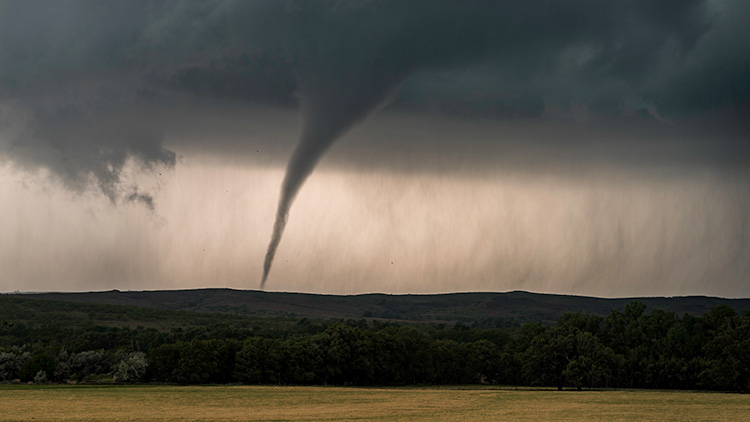
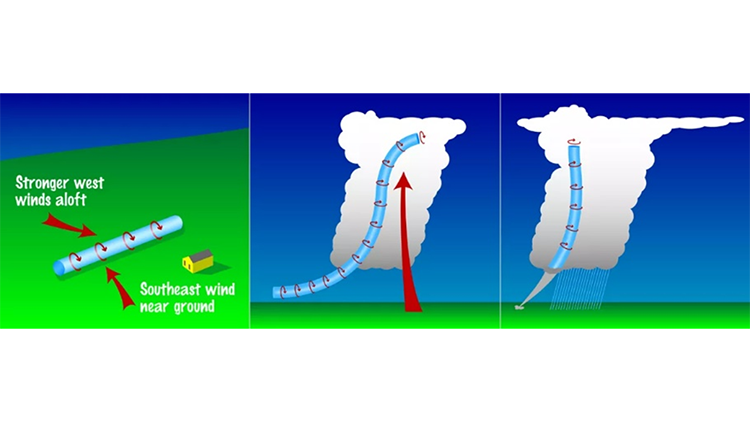
In some thunderstorms, called supercells, the updrafts start to rotate, or spin. This happens when the wind is blowing in one direction near the ground and in another direction higher up in the atmosphere. In a different area of the supercell, the cooler air that has moved down toward the ground also starts to spin. This spinning column of air starts out horizontally. But it can be pulled up, vertically, by the larger updrafts that are also spinning. A funnel cloud (a rotating column of condensed water droplets the extends down from the base of a thunderstorm) can form. If the funnel cloud touches the ground, it becomes a tornado.
Most tornadoes last for about 10 minutes. They break up when the cold air moving down from the storm gets under the warm air near the ground. A tornado may end when the thunderstorm weakens. Running into hills can also break up a tornado.
What Can You Do? Why do meteorologists watch thunderstorms closely for any rotation?
Photo Credit: (t)NOAA/JPL-Caltech, (b)Willard Sharp/500px